Anecdotally, you’ll often hear that Board Certified Behavior Analysts (BCBAs) and Speech Language Pathologists (SLPs) just don’t get along. They misconstrue each other’s practices, refuse to follow each other’s recommendations, and overall step on each other’s toes. But what if, instead of competing for attention, clinicians learned how to collaborate?
At the end of the day, every clinician’s primary goal is to provide the best possible care for our clients. The best way for clinicians to approach this goal is by working together. Within every workforce, there is a time to lead and a time to give space to your colleagues. Every clinician is an expert in their own field with their own scope of knowledge and competence. Learning to trust and collaborate with clinicians from a variety of disciplines helps you become a better colleague.
In this article, we will talk about the areas where SLPs and BCBAs overlap, and where they diverge. Additionally, we will offer some tips from our own clinics that encourage collaboration between SLPs and BCBAs.
The Research
According to the 2022 article “Implications for cross-training between applied behavior analysis and speech-language pathology,” while SLPs and BCBAs share a similar scope of practice, their methods, theories, and even vocabulary vary widely.
The article pulled data from nine separate articles to assess how each discipline approaches language development. BCBAs are focused on observable, external expressions of communication. They want to be able to point to observed data that shows an individual’s comprehension has improved. SLPs are much more concerned with an individual’s internal, cognitive understanding of communication. This alone points to why clinicians from the two disciplines experience so much tension; they’re approaching the same problems from completely different perspectives.
https://digitalrepository.unm.edu/cgi/viewcontent.cgi?article=1004&context=shs_fsp
Tips for Collaboration
So, now that we know that BCBAs and SLPs are approaching the same problem with different tools, let’s talk about how BCBAs and SLPs can begin to work collaboratively.
Graphic Credits to ABAI
Scope of Practice vs Scope of Competence
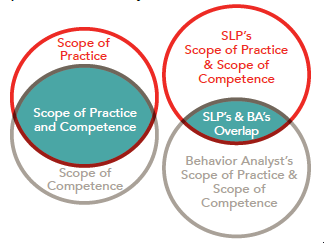
Scope of Practice refers to the tasks your license legally allows you to practice in your area. Scope of competence refers to the services an individual contractor is personally qualified and skilled at providing.
Each of us has our own scope of competence and scope of practice.
When working with a practitioner from a different background, there is overlap in both the scope of competence and practice. However, there’s also a whole world of things that every clinician works on that you might not know anything about. Always assume that each person is an expert in their own field. Just like you went through a lot of work and education to get where you are now, so did the people you’re working with. Acknowledge that their scope of practice and competence differ from your own, but that does not make their work less valid. You each bring something unique to the table.
Recognize Each Other’s Strengths and Find Opportunities for Collaboration
Speaking of unique: This graphic from ABAI compares the strengths of each discipline, as well as areas for potential interprofessional collaboration. What this document points out at a glance is that these two disciplines have two separate, but both important, skill-sets.
SLPs and BCBAs both work to improve communication. However, as we noted above, each discipline will relate to that goal with different strategies. This is a good thing, as each individual brings different strengths to the team.
The ‘Opportunities for Collaboration’ section names specific areas where practitioners can help each other. SLPs struggling with data collection should ask a BCBA for their advice. If a BCBA has questions about the physical acts of articulation and phonation, they should reach out to a SLP. Interprofessional collaboration can inform the way you approach your own practice.
Avoid Jargon
Because Speech-Language Therapy and Applied Behavior Analysis are two different disciplines, they have completely different sets of jargon. When collaborating with a practitioner from a different background, spare yourselves the confusion and agree to use plain language with each other. This will reduce frustration and confusion between the two of you.
Communicate About Philosophy and Approach
In our business, everyone is short on time. So when we say it’s important to set aside time outside of a session to talk with other clinicians, we mean it’s really important. Even just a fifteen-minute chat can help you and the other person find common ground, understand their current goals, and gain insight into *why* they’re doing things the way they are. Especially if something another person is doing really bugs you-ask about it! There is a method to everyone’s madness. Lead with curiosity and compassion.
For example, let’s talk about if a client is using a multitude of different communication methods at home. Behavior analysts and speech-language pathologists might have completely different takes on this. A behavior analyst might see the lack of consistency and structure and worry that this is impeding progress. But a speech-language pathologist might not be worried; instead, they may be excited to see the learner engaged in communication through a variety of methods.
Talk about your individual strengths and weaknesses, your competencies and where there’s room for growth. Together, you can play off of each other’s strengths and acknowledge the roles you each play in the learner’s development. This way, you can also give each other permission to “jump in” ahead of time.
Embracing collaboration in your work will strengthen your practice. Most importantly, though, it will put the focus back where it belongs: on providing the highest quality of services to our clients.
About CoachABA
CoachABA is the educational wing of Applied Behavioral Advancements, LLC. CoachABA is both a tool for up-and-coming ABA professionals, and a platform for encouraging ongoing education for those already working in the field.
Our supervision program began from the genuine desire to figure out a better way for BCBA candidates to get supervision hours. CoachABA provides training and supervision for individuals on their way to becoming a BCBA. Our program meets all requirements of board certification, as well as competency items. Our goal is to help you pass the first time, while also assuring all your i’s are dotted and your t’s are crossed when it comes to your paperwork.
About ABA-LLC
ABA-LLC is one of the largest suppliers of Behavior Support in the State of Kentucky. Since 2007, the agency has created innovative strategies to improve the lives of unique individuals. ABA-LLC works with around 190 contractors, each dedicated to building an inclusive culture that celebrates individuals of all abilities. No matter who you are, you can reach your goals at ABA-LLC.
ABA-LLC is set apart from its competitors by its uniquely person-centered approach. The agency strives to provide services from a place of deep love for the population they serve. Their work exemplifies the belief that every individual has a right to live a fulfilling and independent life integrated within their communities. There is no objective to change a person, but rather to give them the tools they need to succeed. B.F. Skinner summarizes this vision in his quote: “I’m not trying to change people. All I want is to change the world in which they live.” Learn more about us at https://aba-llc.com/